Showing posts with label San Diego Bay. Show all posts

Tuesday, September 17, 2019

"PENELOPE" - A STORY OF LOVE AND LOYALTY.


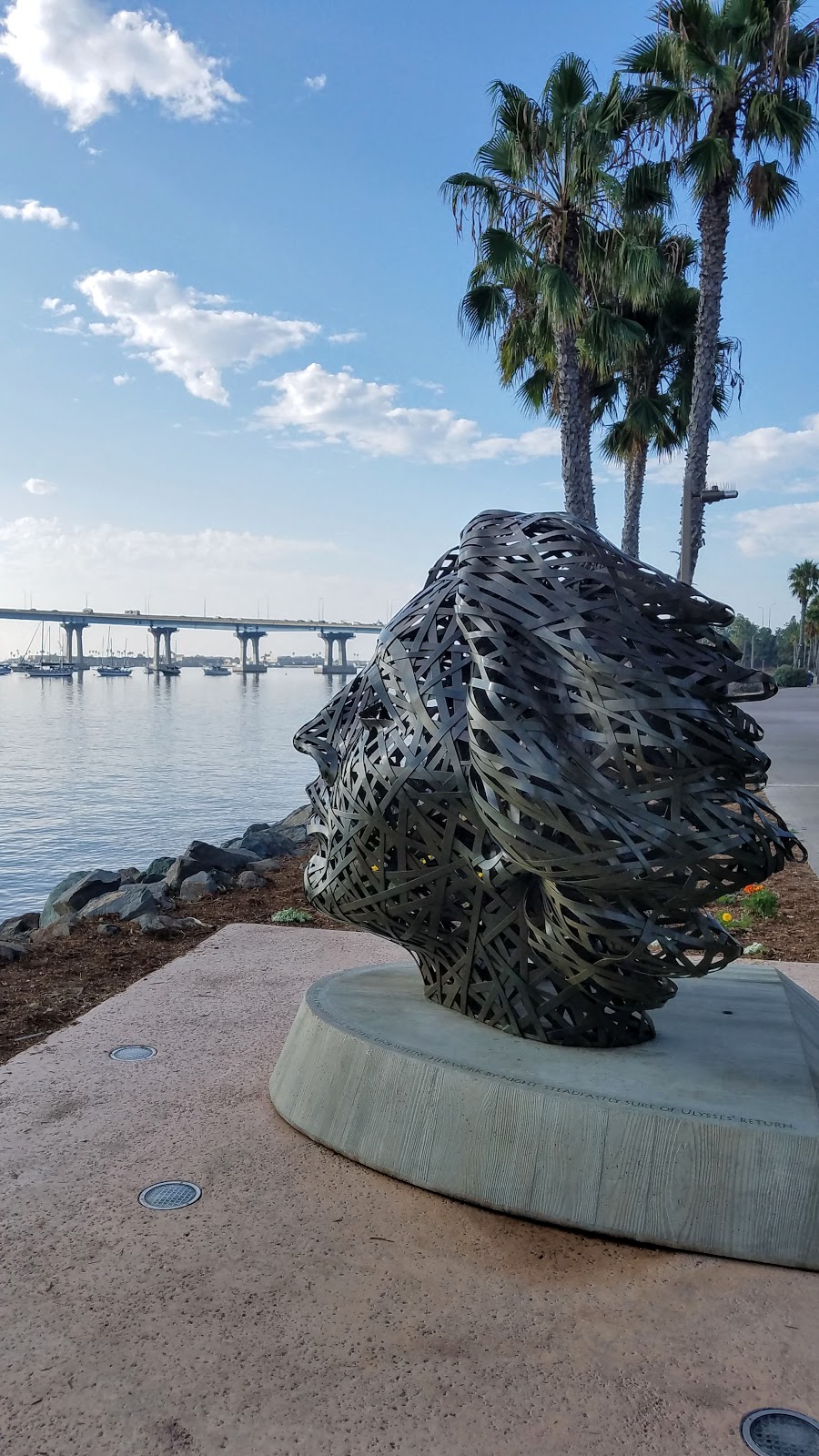
A stunning sculpture of Penelope (2009) by Temecula artist, Michael Stutz, now stands majestically at the northeast corner of Tidelands Park in Coronado, California. She faces the San Diego Bay with a view of the seagoing ships that pass by daily—an appropriate setting for Penelope who waited 20 years for her husband, Odysseus, to return from the Trojan War. Printed along the bottom of the display is a famous quote from The Odyssey: “Weaving by day, Penelope would be forced to choose a new husband when her tapestry was complete. But all the while she waited, unraveling her work by night, steadfastly sure of Ulysses' return.” According to the epic poem, she denied 108 suitors until her husband finally returned, and they lived happily ever after.

The appearance of this seven-foot-tall sculpture varies with the time of day and the perspective that you might be viewing it from. It was hand-fabricated with long strips of bronze metal that appear to be weaved together, symbolizing the story of her weaving by day. Spectators can also climb inside of Penelope's head and look out at the Bay through her eyes—children especially like this experience. My granddaughter enjoyed sitting on the small built-in bench she found inside the head. 
Penelope was originally on display at the Embarcadero until it was removed for the construction of Ruocco Park and stored for eight years, awaiting a new home. Thanks, to the Port of San Diego Waterfront Arts & Activation department for having the foresight to choose this lovely location and to provide another wonderful work of art for the public to enjoy for years to come. Not surprisingly, the sculpture of Penelope has already been referred to as the masthead of Tidelands Park.


Add caption
WAITING FOR SHIPS TO RETURN SAFELY
2020 CORONAVIRUS PANDEMIC


Monday, April 15, 2019

THE NOT SO "VINTAGE BANANA BOAT" -----SAN DIEGO BAY


It's 5:20 on a Sunday morning, and I hear activity outside. I take a look and notice the arrival of the Dole Caribbean—moving quietly and slowly into the San Diego harbor. Before mooring, it makes a large swooping turn in the bay so that it is facing outbound for departure. It's still dark, and there are a few faint lights on the side of the vessel and brighter lights inside the bridge that is located high up and to the rear of the ship. 


Five years ago I wrote a favorite post entitled: “Vintage Banana Boat—San Diego Bay.” These banana boats continue to roll in and out of the bay on a weekly basis, typically arriving early Sunday morning and departing late Tuesday evening, bringing a source of joy to observers. I'm writing another post at this time because new ships have been assigned to the San Diego route and I've had the privilege of touring one. 

In 2018, the Dole California, Dole Ecuador, Dole Honduras, and Dole Costa Rica (that I refer to in my May 2014 post) were refurbished and reassigned to a new delivery route. They were replaced by three larger, newly-built vessels: Dole Pacific, Dole Atlantic, and Dole Caribbean. Built in South Korea (2015-16), they have almost twice the capacity of the previous ships. They are similar in color and style--I didn't even realize there was a change until it was brought to my attention by a representative from Dole.
Michele & Sue on the deck of Dole Atlantic


It was a bright sunny March day when my friend and I headed over for a tour of the Dole Atlantic that was moored and preparing for departure to Ecuador that evening. The ship tour was conducted

by Captain Nelesh, and it soon became apparent as to why he is referred to as “everyone's favorite captain.” Before climbing the many steps up to board the amazingly huge ship, Sarah Marsh, Terminal Manager, gave us a brief tour of the 20-acre Dole ground facility.


The captain-led tour extended from one end of the ship to the other with a chance to see the steering and the navigation systems located at the top and rear of the ship to the gigantic anchor and ropes located in the front. It also included a visit to the dining areas that are used by the 21 crew members and the kitchen where the food preparation takes place (by only one cook). We also saw the cranes in action as they moved the huge containers on and off the ship. Finally, we met the Chief Engineer and saw the extensive engine room that occupies four floors. The cargo ship was immaculately clean and equipped with an elevator, however, there were still many steps to climb. 

It was a fun morning and we enjoyed hearing many sea-related stories including one about the seagulls that catch a free ride on the ship as it travels along the coast of Mexico. Seamen are known for their superstitions. One of them is: “Seabirds are thought to carry the souls of dead sailors and it is considered bad luck to kill one. However, it is considered good luck if you see one.”


The vessels are 623 feet long—almost two times the length of a football field. They are outfitted with two electro hydraulic cranes and the most technologically advanced engines and electronics available. When the ships arrive full, they carry approximately 760 reefer containers and 60 million bananas. (About 20% of each shipment consists of pineapples.) The three-day turnaround in San Diego is amazingly quick. Thanks to the help of a sophisticated computerized tracking system, the loads move efficiently from ship to truck to store in the same refrigerated containers.  


The three ships rotate through the terminal on a 21-day cycle. When they depart San Diego they are approximately 95% empty. They return, about 18 days later, from Costa Rica, Guatemala or Ecuador, with a full load. 

Dole Food Company, based in Westlake, California, is the largest producer of bananas and pineapples in the world. It owns and maintains a fleet of 21 refrigerated cargo ships at five locations throughout the U.S. The San Diego port services California and all areas west of the Rockies including Canada and Alaska.
                                                          **** 
      Interesting banana facts:

--The highest average per capita consumption of bananas in the world is in Uganda, where residents eat an average of 500 pounds of bananas per person annually. (The average American eats 28 pounds per year.)
--Bananas are technically berries. Banana plants grow up to 25 feet high and it takes them about ten months to produce fruit. 
--There is an International Banana Museum located in Mecca, CA (just south of Palm Springs) that contains more than 17,000 banana items. It is said to have the world's largest collection devoted to one fruit. 
Michele, Captain Nelesh, Sue

Sunday, March 29, 2015

PORT OF SAN DIEGO EXPANSION

The day we moved into our new home, as I was hastily trying to get organized, I looked out my window at the San Diego Bay and noticed, for the first time, an ocean-going vessel pass by. Since then I have seen hundreds them. They come intermittently at a slow speed, so there is always plenty of time to view them. Besides the large cargo ships, there are kayaks, paddleboards, sailboats, yachts, fishing boats, ferries, party and sightseeing boats—the parade never ends.

NAVY TUGBOAT  CELEBRATION
The naval ships pass by on their way to and from Naval Base San Diego, also called the 32nd Street Naval Station, which is the largest US Navy base on the West Coast. It is most impressive, on those infrequent occasions, when the ship is returning from many months of being on assignment. The naval personnel are lined up on the deck, the front is adorned with a large wreath, and they are lead by a tugboat with a fountain of water flowing from it. Band music can be heard from the dock, and I can only imagine the happy families that are waiting for them there.
US NAVY SHIP- SAN DIEGO BAY
Since I am fond of watching the ships float in and out of the bay, I read with interest the news that the Port of San Diego may become even busier. It is currently proposing to modernize the Tenth Avenue Marine Terminal, located off Harbor Drive and Cesar Chavez Parkway. If this gets approved, it will lead to San Diego becoming a leading West Coast specialty port—comprised of the Tenth Avenue Marine Terminal (TAMT) and the National City Marine Terminal (NCMT). San Diego is desirable because it offers a natural, protected harbor that is uncongested as well as a year-round mild climate.
“The Economic Impact of the San Diego Unified Port District 2/25/15” was recently prepared by the Economic & Planning Systems, Inc. This annual study indicates that the Port of San Diego contributes more than $7.6 billion a year into the region from employment, sales and purchase of goods and services. This makes it the second-largest employer in San Diego County, after the state of California. It is the primary port of entry for Honda, Acura, Isuzu, Volkswagen, Nissan, Mitsubishi Fuso, and Hino Motors into America. It also holds a twenty-year lease with Dole Food Company, bringing in much of the country's bananas.
The Port of San Diego controls more than 60 percent of the Bay shoreline, or 33 of the 54 total miles—the Navy controls 17 miles. It oversees two marine cargo terminals, two cruise ship terminals, the Harbor Police Department, and leases of almost 600 tenants and subtenants along San Diego Bay. In addition, it oversees 20 public parks, including the newest waterfront park, Lane Field, that opened on March 16. Located on the corner of West Broadway and North Harbor Drive, it was once the site of Lane Field where the original Pacific Coast League Padres played from 1936-1957. It is named after Bill Lane, who was the owner of the Pacific Coast League Padres in 1936.
A helpful tool that makes observing the vessels more interesting is marinetraffic.com It provides the location of all the ships in the area along with the name, type of ship, a photo, current location, itinerary, home port and other details.
The San Diego Bay appears reasonably clean and odorless, however, it is far from perfect. A federal list that identifies unhealthy waters, called the 303(d) list, includes San Diego Bay for 20 separate pollutants—including copper, mercury, PAHs, PCBs, zinc, and chlordane—along with general toxicity in the bottom of the the bay. Sources of the pollutants are urban runoff and copper-based paints on boats. There are signs posted at all piers along the bay warning anglers that fish may contain chemicals believed to cause cancer and birth defects.
The proposal to expand the terminal and increase the traffic is now waiting the results of a Notice of Preparation for a Draft Environmental Impact Report issued by the Port of San Diego. The public and other interested parties now have an opportunity to comment on possible environmental impacts of the project. Comments will be accepted until 5pm on Tuesday, April 14, 2015.
US NAVY  SHIP ADORNED WITH WREATH
DOLE CARGO SHIP