Showing posts with label Ireland. Show all posts

Friday, March 17, 2023

THE COLORFUL DOORS OF IRELAND


I'm wishing everyone a Happy St Patrick's Day, not because I'm Irish, or have a love for green beer or corn beef and cabbage. But, because I've been to Ireland and it is one of the most beautiful and welcoming countries I have ever visited. I
 especially love the bright, colorful doors and the belief by many that there is a warm welcome behind every Irish door.

The Irish are known for storytelling and there are many tales as to why the doors are multicolored. One of the legends is that when Queen Victoria passed away in 1901, Dubliners were ordered to paint their doors black to mourn her death. In rebellion, they painted them in bright colors instead.


Some believe that the bright doors were painted by the wives who wanted to ensure that their drunk husbands returned to the right home at night.

Or perhaps they were just painted to brighten one's mood when the persistent rain and gray skies of Ireland prevail. 

Related Posts: "More Than a Door"      May 11, 2020                                  "Vintage Doors in LePanier, the oldest District in Marseille, France"      May 29, 2022


"OPEN THE DOOR, IT MAY LEAD YOU TO SOMETHING UNEXPECTED"


"TODAY IS A PERFECT DAY FOR OPENING A NEW DOOR"


"OLD WAYS WON'T OPEN NEW DOORS"


"TAKE A DEEP BREATH, YOU'RE HOME NOW"


"IF IT DOESN'T OPEN, IT'S NOT YOUR DOOR"

"LEAVE YOUR EXCUSES AT THE DOOR"


MAY YOUR TROUBLES BE LESS,
AND YOUR BLESSINGS BE MORE,
AND NOTHING BUT HAPPINESS,
COME THROUGH YOUR DOOR.
  -Irish Blessing


Saturday, July 14, 2018

A VINTAGE WALK IN DINGLE


DINGLE COAST WALK

The weather in Ireland is often rainy and cool, but not today, it was 70F and sunny, a perfect day for a walk in Dingle (pop. 2,000). We headed to the Tourist Information office to get a recommendation for nearby hikes. The woman at the desk immediately suggested a path along the water that started at the end of Coolen Street, a short walk away. It followed along Dingle Bay and then continued for miles on the cliffs overlooking the Atlantic Ocean. She also suggested a picnic and said that we could get our supplies at the Super Value across the street. It sounded perfect, and we were on our way.

HUSSY'S FOLLY
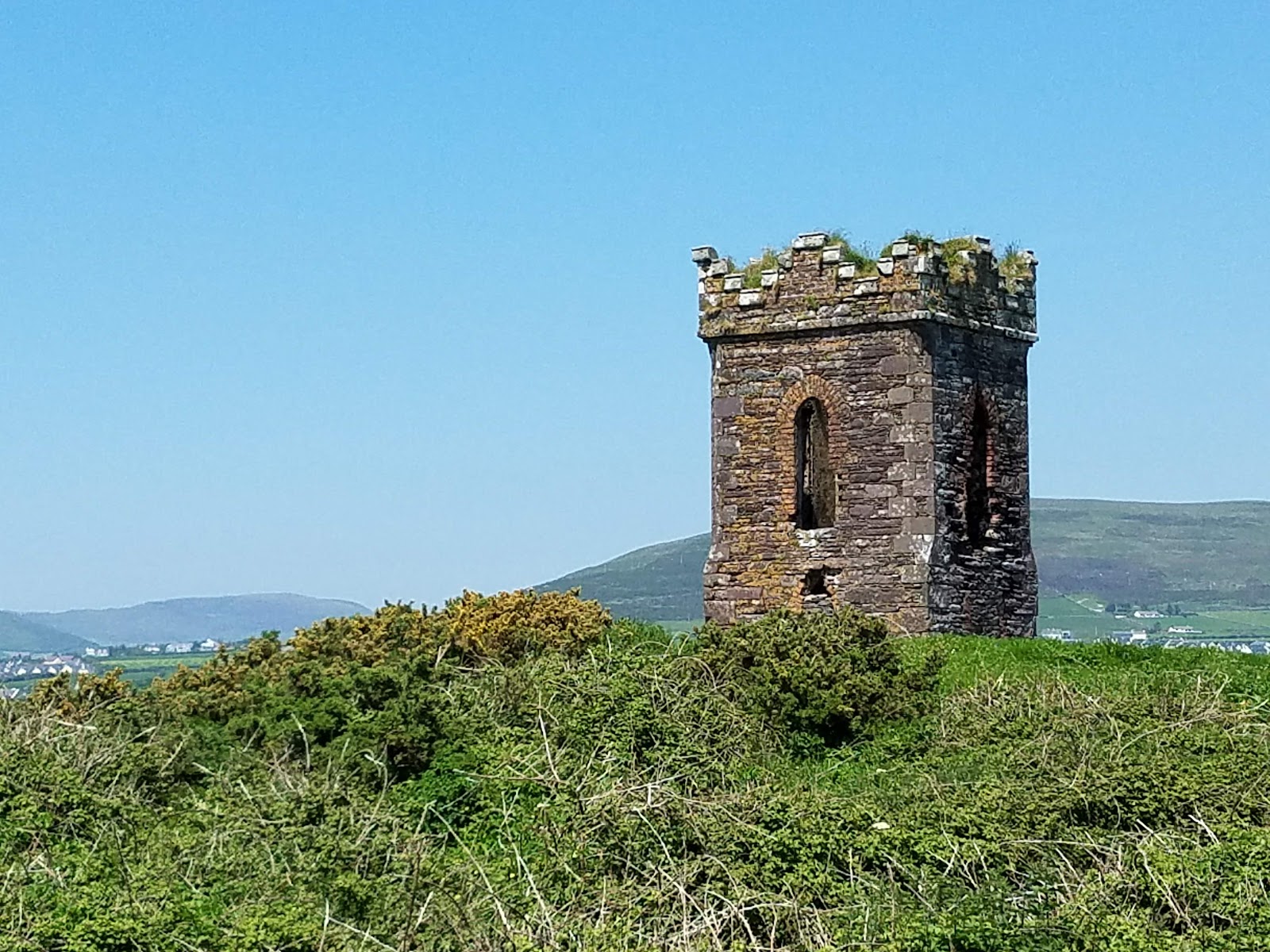
I will refer to the hike as the Dingle Coast Walk, however, some call it the Lighthouse Walk. It passes by an intriguing brick tower called Hussy's Folly that dates back to 1845. It was built during the Great Famine as a means of providing employment for the poor. 

The tower and nearby beach are also popular sites to view dolphins and Fungi. Fungi is the resident Dingle dolphin that was first spotted by fishermen in 1983 when he was said to escort the fishing boats out to sea and then back again. He continues to be popular with visitors who often take boat tours to get a close-up view of the little guy and sometimes even try to swim with him. 

DINGLE COASTAL WALK
The path extends for miles beyond the lighthouse and tower and offers a view of the Lighthouse along the way. Ron returned to town at the lighthouse, however, I continued on. The views of the Atlantic Ocean, with its steep craggy black cliffs, became increasingly more spectacular. My goal was to reach the top of a distant cliff that appeared to be the end of the trail. I stopped a few times to sit on the boulders and take in the views of Kerry Peninsula and the lush green low mountain ranges across the way. I felt fortunate to have it all to myself. 

DESERTED BEACH DINGLE COAST 
As I was walking back, I couldn't resist a walk down to a small deserted beach surrounded by cliffs and pointed rocks and boulders. The place was quiet today, but this will change soon as the summer season approaches. I stopped to collect some shells before continuing on. 

DINGLE HARBOR
The return walk also offers an expansive view of the entrance to the Bay, and the Dingle Harbor that was one of Ireland's main trading posts in the 15th century. Today it is a major fishing port. 

The path on this walk crosses through private property; a common practice in much of Europe. The entryways to the pastures are narrow with steps up to prevent the livestock from passing through. The cows just look on and don't appear to be bothered by visitors. When I did some research on it later, I discovered that Ireland, unlike England and Scotland, has a restrictive policy and in most cases, the walker has no right to be there. For more information click here.


                                                          * * *
The harbor town of Dingle is the only town on the Dingle Peninsula and is the starting point of the famous Slea Head Coastal Drive. It is quite popular and advance reservations for tours and lodging during the peak summer months are almost essential. I booked Rory Brosnan's Dingle Slea Head Tour two months ahead, and it was a great tour. Unfortunately, the cruise to the Blanket Islands was sold out when we arrived—I wish that I had booked that one early as well.

Related Posts: Stone Fences & Walls of Ireland - June 27, 2018
                        Ireland: Nine Reasons to Return - June 14, 2018


Wednesday, June 27, 2018

STONE FENCES & WALLS OF IRELAND

ARAN ISLANDS
Ireland is a beautiful country with lush green expanses of open countryside and farmland. Just below the surface of this lush green lies a thick layer of limestone. This Irish blue limestone is the source of the fascinating dry stone fences that can be found throughout the island, and are particularly abundant in the counties of Galway and Mayo on the west coast. 


It was one of our first days in western Ireland when we were driving along the northern shores of Galway Bay, that I began taking an interest in the fascinating patchwork quality of stone fences all around us. 


The ancient tradition of stone fences dates back nearly 4,000 years when stone walls extended over five square miles in the Ceide Fields of County Mayo. However, most of the fences date to the 1840s when land was redistributed and the stone walls defined the field and helped to clear the land at the same time.

The builders from each area had their own style. None are exactly the same. Some were put together loosely by farmers without much skill. They used stones lying around, irrespective of their size or shape—clearing the field at the same time as they were building boundaries. 


Others were built by skilled stonemasons who knew just how to pick the right stones and interlock them resulting in few or no gaps and extreme stability. Locals often know at a glance who built the wall by simply looking at the way the stones are placed.

One of the joys of my leisurely walks in Ireland was taking time to notice the delicate flowers, ferns, vines, and moss that grow out of the old craggy walls. Over time organic material has built up between the stones, allowing plants to take root, giving the walls an appearance of almost being alive—changing with the seasons and getting better with age—just like wine. 


There are many fascinating things about the Irish culture. However, I will always be impressed with the builders that seemed to have an innate ability to spot the right rock and then pile it in just the correct place so that the walls would be around long after they were gone. There is a saying in Ireland: “Stone walls last forever—and men don't."

ARAN ISLANDS

BRIDGE  IN CONNEMARA


Thursday, June 14, 2018

IRELAND: NINE REASONS TO RETURN


We just returned from Ireland. I'm now sitting back in the comfort of our home with time to reflect on our four weeks of travel. Here are some of the special things about the country that I will miss:


--The beauty of the lush green landscape that is sprinkled with lovely lakes, hills, and mountains.


--Beautiful sunshine days – rarely experienced by the Irish—the locals were constantly telling us how lucky we were.


CLIFFS OF MOOR
--Splendid walks along the sea cliffs overlooking the Pacific Ocean and the Irish Sea—walking paths through forests and lake country.


--Mussels from the nearby sea, warm goat cheese salads with beets, and seafood pies.


--Sitting in a pew of the old St Andrews church in Dublin where Ron's great grandmother was baptized in 1861. This was followed by a walk down the nearby street where the family lived.


--The kindness of the Irish people who were always willing to go above and beyond to help us, including the woman who insisted that we jump in her car so she could drive us to our destination.


--The talented musicians that entertained us in the small pubs—including the stories they shared about the Irish songs.


-- An appreciation of America that's not typical of other countries in Europe. Most of the Irish people we met told us they had relatives in the US and had also visited there.


--The ancient stone fences and walls of limestone that continue to prevail in most of western Ireland. The sheep that wander so freely and peacefully in the green pastures and even onto the roads.

                                                * * *

I'll soon be writing more about unique island and the people we met along the way. Was it a perfect trip? No, they never are. Life isn't perfect. But the beauty of that green lush country and a love for Ireland will stay with me forever.