Thursday, October 16, 2014

THE HUNTINGTON LIBRARY, ART COLLECTIONS, AND BOTANICAL GARDENS

THE DESERT GARDENS

HUNTINGTON'S MANSION
VERANDA

      The Huntington Library, Art Collections, and Botanical Gardens are located in a residential neighborhood of palatial homes in San Marino, CA, about twelve miles from downtown Los Angeles. The property was originally called the San Marino Ranch when it was purchased by Henry E. Huntington in 1903. He was a successful investor in the railroad industry and real estate. His special love and knowledge of books, art, plants, and trees resulted in his amassing one of the finest research libraries in the world, significant art collections, and gardens.
      When Henry first purchased the working ranch in 1903, it was covered with citrus groves, alfalfa crops, poultry, and small herds of cows. Working with his superintendent, William Hertrich, Henry developed over 120 acres into gardens of rare and exotic plants from all over the world. Among the most popular is the Japanese Garden, which includes a drum bridge, Japanese house, and walled Zen garden. The desert garden is one of the largest cacti and succulent gardens in the world with over five thousand species of plants. You couldn't miss the sweet scents when walking through the rose gardens.
      We arrived when it opened at 10:30 am on October 4, and with a weather forecast of over 100 degree F, it was not crowded. Due to the heat, we were the only ones to join the one and one-half hour garden tour. Fortunately, our informative guide made sure stops were in the shade.
      There are currently more than three thousand trees on the property, including hundreds of Huntington's favorite oak and palm trees. Our guide pointed out the Pinus coulter, which produces the largest cone of any pine tree species. Its nickname is the widow maker because the cones can weigh up to ten pounds (people are actually advised to wear hardhats when working in Coulter pine groves). I could easily spend many more hours perusing these twelve lovely gardens, especially in the spring when the roses and camellias are at their peak. There was a large shaded veranda at the front of Huntington's mansion with comfortable chairs—not a bad place to take it all in on such a warm October day.
      After our tour through the gardens, it was time to move into the three air-conditioned buildings that house the art collections and library. Our first stop, the Virginia Steele Scott Galleries of American Art, includes 18 rooms full of paintings, sculpture, and decorative arts from the colonial period through the middle of the 20th century. My favorite piece of work is by an American artist, Mary Cassatt (1844-1926), entitled Breakfast in Bed. I think I was partial to the painting because it reminded me of my daughter, Anna, and her baby, Mila.
Breakfast in Bed  by Mary Cassatt
      Next, we visited the Huntington Art Gallery which offers magnificent works of art, and an opportunity to see the original early Huntington residence. Although many of the rooms have been converted into art galleries, one still gets a glimpse of the opulent lifestyle of one of the richest families in America in the early 1900s. The focus in this gallery is European art from the 15th to the early 20th century. Among the famous paintings is the Blue Boy by Thomas Gainsborough (1727-1788). This was purchased by Henry Huntington in 1921 at a price of $640,000 ($8.5 million in 2014), making it a record price for art at the time.
Blue Boy by Thomas Gainsborough
      At the entrance to the mansion is a life sized painting of a stern looking woman with thick black- rimmed glasses, dressed in widow's weeks. It is Arabella Huntington, the second wife of Henry, and before that, the second wife of Henry's uncle Collis Huntington. After the death of Collis in 1900, she always wore black when in public even after marrying Henry in 1913. They married in their 60s, and shared interests and expertise in collecting. The story of her life from modest beginnings to becoming one of the richest women in the world is fascinating. I am looking forward to reading the well researched 2013 book: The Art of Wealth:The Huntingtons in the Gilded Age by Shelly M. Bennett.
      Our visit would not have been complete without a stop at the Library where Henry E. Huntington collected millions of rare books and manuscripts. It's considered the largest library ever assembled by one person and currently holds about nine million items. Among them is a Gutenberg Bible on vellum and a world-class collection of the early editions of Shakespeare's work. For qualified scholars, it is one of the largest and most complete humanities research libraries in the US.
      We left about 4:30 when they closed—glad to have had a full day visit without rushing—the vintage way. By then we were hungry and thirsty so we stopped at Maria's Italian Kitchen, 3537 E. Foothill Blvd, Pasadena. It was a good choice. Ron had three rather large meat balls with melted cheese over them and I enjoyed a caprese salad and french fries. Later we walked around old Pasadena, enjoying all the activity and peering into the interesting restaurants and shops.
      We are fortunate for the generosity of Henry E. Huntington who left his entire estate in a public trust for all of us to enjoy.

Garden Door

The Long Leg by Edward Hopper 

The Gutenberg Bible
Desert Garden
Japanese Gardens
Chinese Gardens


Friday, September 26, 2014

VISIT TO THE NAVAL AIR STATION, NORTH ISLAND CORONADO

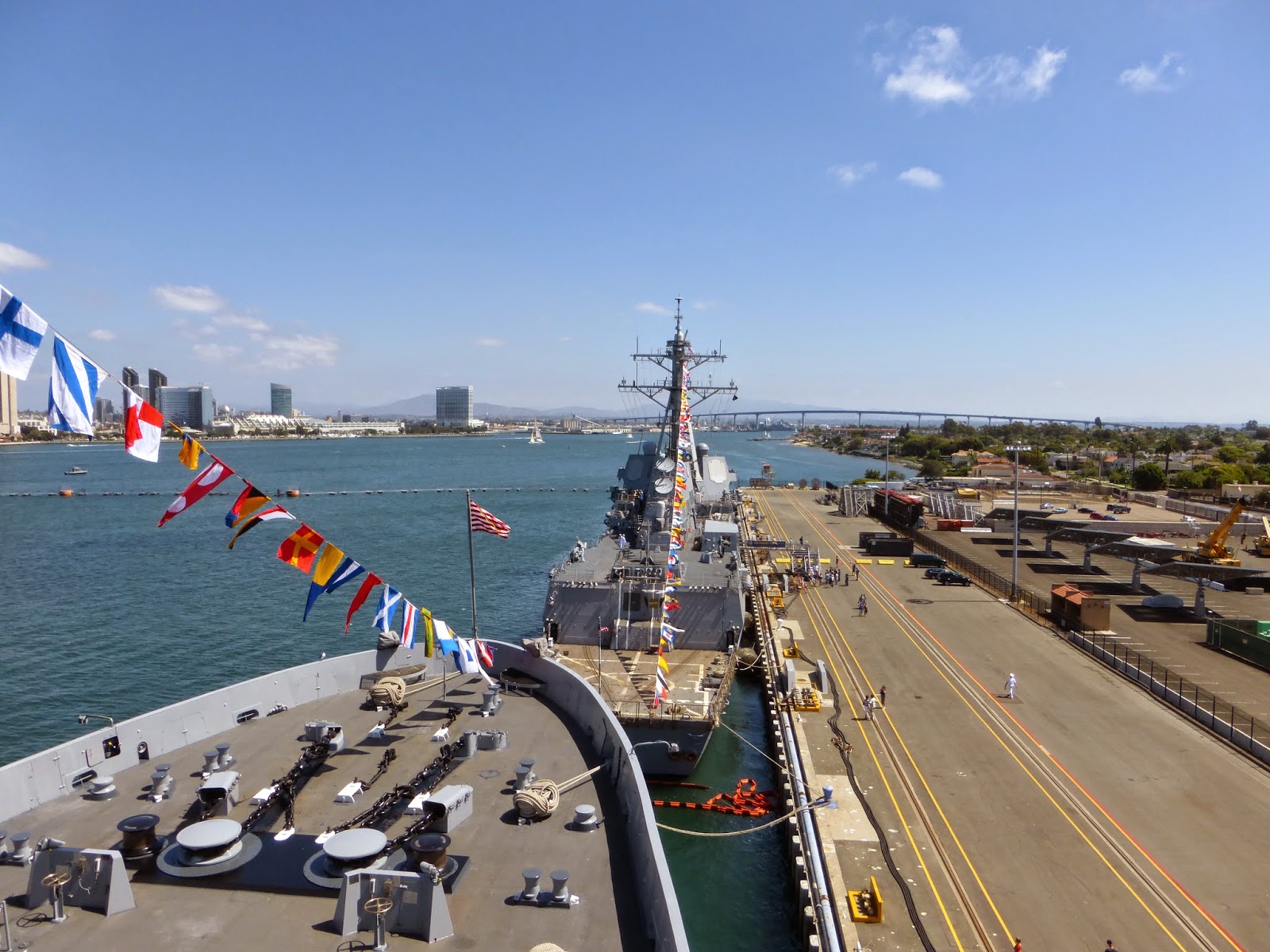
USS PINCKNEY (DDG 91)
Motto: "Proud to Serve" 

USS PINCKNEY & USS SOMERSET
CORONADO BRIDGE IN BACKGROUND

      It's Fleet Week in San Diego with many opportunities for the community to honor and celebrate the men and women of the military.
      It is during this time, on September 21-22, 2014, that the public is invited to visit the Naval Air Station North Island, and to enjoy free tours of three active US Navy ships. The chance to personally board and walk around these huge technological wonders is an opportunity that Ron and I could not resist.
      We found it interesting to drive through the main gate, and then drive through the base, normally off limits to the public, to the parking lot. NAS Coronado is the largest command center in the southwest region of the US. It resembles a small city and employs over 24,000 military and civilian personnel. It is also famous for being the Birthplace of Naval Aviation.
      After parking and going through security, we walked a short distance to where the buses were loading to head over to the ships. We were in line for about one hour. It started out as a cloudy morning, however, the sun finally came out and it was warm. Once we reached the docks, we had the options of boarding a destroyer, an aircraft carrier, and an amphibious transport dock.
      Our first stop was the destroyer, USS Pinckney (DDG 91), home based in San Diego. The uniformed Navy personnel conducting the tours and greeting the visitors were polite and friendly. There was plenty of time for questions during the one-hour tour. It did require walking up (and then down) six floors of narrow steep stairwells that were definitely not made for tall persons—at 5'7” that would include me. We also got to sit in the captain's chair at the bridge of the vessel.
VINTAGE RUNS THE SHIP


      Our next visit was the USS Nimitz (CVN 68) which was launched in 1972 and weighs 101,600 tons. It is the super carrier of the US Navy and one of the largest warships in the world. Formerly based in Coronado, the home port is now Everett, Washington. At 1,092' in length, it is twice as long as the Pinckney (520 ft). It was fascinating to see the magnitude of the deck where aircraft are launched with the help of a catapult.To get to the flight deck, we rode the gigantic airplane elevator without walls.
      Finally, we boarded the USS Somerset (LPD 25), an amphibious transport dock based in San Antonio, TX. Commissioned in 2014, it's the newest ship in the Navy. Its namesake and motto “Let's Roll” are to honor the bravery of the passengers and crew on hijacked United Airlines flight 93 that crashed in Somerset County, PA. In addition, street names from Somerset are hung along the hallways throughout the ship.
      We then returned to the center, where there were dozens of aircraft, military boats, and vehicles for viewing. Most of them could be boarded, which was extremely popular with the children. We found the representatives at each display to be very informative.
      After four and one-half hours of walking and standing in the sun, we were tired and ready to head out. Unlike most events, this one did not offer food for purchase so we were hungry as well. On the way home we stopped at our favorite restaurant, the Coronado Brewery, where Ron enjoyed his usual bratwurst burger and beer.
      Thank you to the men and women in uniform who so valiantly serve our country. They deserve our support and prayers in this time of uncertainty in the world.
TOUR GUIDES
USS PINCKNEY (DDG 91)
USS NIMITZ

USS NIMITZ (CVN 68)
FLIGHT DECK RUNWAY


DRONE
SCORPION TWO

USS SOMERSET (LPD 25)
MOTTO "LET'S ROLL"

Wednesday, September 17, 2014

AARP "IDEAS @50+" VINTAGE INSPIRATION AT ITS BEST

SAN DIEGO CONVENTION CENTER
Photo from WePartyPatriots.com
     It seems as though top events often come to “America's Finest City.” AARP'sIdeas@50+ was definitely one of those. A long list of celebrities and experts that this event brought to San Diego included Martha Stewart, Guy Kawasaki, Kevin Spacey, Erin Brockovich, Arianna Huffington, Julia Louis-Dreyfus, Michio Kaku, Ph.D. The presentations were open to everyone; however, you needed to arrive at least 15 minutes early to get a seat for the most popular ones.
     Held annually, the next one will be in Miami, Florida, May 14-16, 2015. At a cost of $35 it's a great value.
     I enjoyed the opportunity to see Martha Stewart, who at 73 is still working and adventuring around the world. As business woman, writer, TV personality, and former fashion model, her lifestyle is beyond what most of us could ever imagine. Her home in Bedford, New York, has 350 miles of riding trails, and she still rides weekly. She hikes in Acadia National Park, which is near to her 35,000 square- foot home in Seal Harbor, Maine. A weekday might include a full day at the office in Manhattan, which is a one-hour drive from her home. The chauffeur drives her back in the evening after a dinner with friends in the city.
Always a proponent of helpful food, she drinks a green juice daily which is usually made with organic vegetables from her own garden. Exercise with a trainer is also on the regimen, three-four times a week. Her latest book, Living the Good Long Life: A Practical Guide to Caring for Yourself and Others, provides advice on living healthier and better as we age.
     A speaker who offered some amazing predictions about the future of the brain was the physicist
Michio Kaku. His recent book, Future of the Mind, reveals the latest secrets of the brain that are now being revealed due to the new technology in computers and high tech brain scans. This includes a “smart pill” that can enhance our cognition; being able to upload our brains to a computer; sending thoughts and emotions on a “brain-net;” controlling computers and robots with our minds. Scientists are now able to take rough photographs and videotapes of dreams with MRI machines. Among the future benefits could be advances that may someday eliminate the pain of mental illness and dementia.
     Another excellent presenter was Arianna Huffington, who is the author of 14 books, including the current best-seller, Thrive. She is the cofounder, president, and editor in chief of the Huffington Post Media Group. After collapsing from exhaustion in 2007, she learned to look at life in a new way. Making the point that our eulogies are never about money and success, but the other stuff: “what we gave, how we connected, how much we meant to our families and friends, small kindnesses, lifelong passions, and the things that made us laugh,” she has redefined success to creating a life of well-being, wisdom, and wonder. She is from Greece, where aging is considered to make life richer.
     As we exited at the end of each day, the loud sound of drums could not be missed. We finally got up enough courage to sit down and join the drum circle that was open to everyone with instruments provided. It was a fun experience, no skill required. This might be a new- found hobby of mine—joining up with drum circles, after all I did play the bass drum in my high school band.
     Favorite quotes from the occasion:
 “Find what you love, and do it regularly.” -Martha Stewart
  “Life is like a train journey, some of the scenery is good and some is ugly, but the train keeps                          moving on.”                 -Arianna Huffington
“It's not about aging, it's about living—don't be defined by your age—embrace it.”
                                    --Jo Anna Jenkins, Chief Executive Officer, AARP

ARIANNA HUFFINGTON
“Live life as if everything is rigged in your favor.” -Rumi (a popular 13th century Persian poet that Arianna Huffington frequently quotes.)
MARTHA STEWART
SAMANTHA BROWN POSTER

IDEAS @50+ PINS 


DRUM CIRCLE

RON PLAYING DRUMS

Thursday, September 4, 2014

SAND SCULPTING ON A VINTAGE PIER IN SAN DIEGO


      It's Labor Day 2014, and I'm heading over to the Broadway Pier on the 9:30 am ferry. It's always a treat to ride the boat between Coronado and downtown San Diego, however, today it is particularly special because I'm going to visit one of the “ten best sand sculpting competitions in the world.”
     The US Sand Sculpting Challenge & 3D-Art Experience is normally held on Labor Day weekend at the B Street Pier in San Diego; this is the 4th and last day of the event. It consists of two levels of competition: World Masters, which are the best from around the world, and local teams. The first day was Friday, which would have been interesting; that's when they begin carving their masterpieces from large blocks of hard sand from river banks. They finish one day later. It's hard to believe they can accomplish these works of art in such a short time.
Shoo-B-Doo-B-Doo
By Kirk Rademaker
      I first observed the Shoo-B-Doo-B-Doo sculpture near the entrance. The artist, Kirk Rademaker, is known as the Sand Guy and is one of the stars of Sand Masters on the Travel Channel. He is a local, and is often seen at the Coronado beach where he produces sandcastles in front of the historic Hotel Del Coronado.
SEED
By JOOheng Tan

      I continued my walk along the pier to see all of the masterpieces including the 2014 winners. The First Place masterpiece was titled, “Seed” or “Anything that provides Imagination for later work.” The artist, JOOheng Tan, is from Singapore. His works, showcased in 50 cities in 20 countries, have won numerous awards. The London Daily Mail refers to him as the Vincent Sand Gogh.

TRIQUETRA
By Sue McGrew

      The second place winner was awarded to the sculpture, “Triquetra.” by Sue McGrew an American artist. She is also featured on the Travel Channel's Sand Masters. The sculpture is in the shape of a triangle with three large peepholes that depict a woman in various stages of her life: young, middle-aged and old. The following statement, that Sue wrote in long hand, was hanging in the wind near her work of art:
To those looking in, life is a mystery that can never by seen in full except by ourselves. Each day is just a sliver, a window into a stage of our life. We can try to freeze that moment in time with a picture, but it hardly captures the instant.”

PEACE OF MIND
By Melineige Beauregard

      The third place honor was given to “Peace of Mind,” by Melineige Beauregard. She is a world famous artist from Canada who won 2nd place at the 2013 Sand Sculpting Challenge. She describes her art as “a means of communication, a way to transmit the energy of life, to affirm its vastness and its beauty.”

We need a bigger boat
By John Gowdy
      The winner of the People's Choice award was called We need a bigger boat by John Gowdy. John is a retired fire captain from New Jersey who is now living in Italy. He is internationally acclaimed as an artist in several medias.
      I continued walking along the pier, enjoying all ten master works and the many team sculptures. At the end of the pier, there's a lovely view of Coronado and the bay with many boats passing by on this popular holiday weekend. In addition, I had the pleasure of seeing two tall ships: American Pride-USA and America-USA, from the nearby Festival of Sail—shooting their cannons directly in front of me.
      In addition to the sculptures, a festive atmosphere prevails here with live music, dozens of food vendors and art booths. I noticed the crowds increasing as the day went on—I was glad that I arrived early to avoid the lines.
      Afterwards, I walked about six blocks to enjoy a cup of coffee in the air conditioned Starbuck's, located at the Headquarters. This is the old police department complex that was renovated and reopened in 2013. It has become one of my favorite places to stop for coffee because of the location and surrounding architecture.

STARBUCKS
HEADQUARTERS AT SEAPORT DISTRICT
AMERICAN PRIDE-USA


AMERICA-USA

EMBRACED
By Helena Bangert


Thursday, August 28, 2014

FOUR-YEARS OF VINTAGE JOURNEYS

ANTHROPOLOGIE
FORUM SHOPS IN LAS VEGAS

    It has been four years since I started my blog, and I look back with fond memories of the day I came up with the name My Vintage Journeys. I was tagging along on a shopping trip in Minneapolis with my daughter, Anna, and her friend Natalie—they were in search of the “right dress” for a coming event. We were in Anthropologie which is an impressive boutique-like store with an underlying mission “to create and seek products that inspire the imagination.”
     Somehow casually walking around, without a shopping agenda, and looking at the creative displays of clothing, accessories, and home decor lead to my inspiration. I don't exactly remember a specific display, but surely the vintage flair of the shop had something to do with it.
     Each one of the over 180 Anthropologie stores worldwide is designed individually with wood-planked floors and vaulted ceilings. I guess that's why the stores are intriguing. Each one is different. Their buyers travel the world in search of unusual decorative objects, furniture and textiles. They visit flea markets in Paris, remote villages in India, and obscure art studios in Turkey.
     Since discovering them in 2010, I rarely pass one of the stores without walking through to enjoy the latest artistic displays and styles. It's kind of like looking at Pinterest. I rarely purchase anything, but it sure is fun to look.
                                                         * * *
     Now that I had the name for my blog—I needed to start the writing. The inspiration for this came from the Jet Blue “All-You-Can-Jet” pass that we had just purchased on a whim. The pass allowed unlimited travel on Jet Blue for one month, beginning in early September of that year. My first post, “Travel Challenge #1,” basically covered the test of putting it all together. As I recall, with all of the connections and 57 cities to choose from, it was far from easy.
     In looking back I managed to post on each of the places we flew to: New York; Bermuda; Fort Meyer, FL; Boston; Burlington, VT; Raleigh, NC; and Chicago, where the trip started and ended. We were living in Minneapolis at the time so Chicago was the closest city that Jet Blue flew to.
CHICAGO

     Although hectic, we enjoyed the trip and would have signed up again the next year if it were offered, but it was not. Like so many things in life, there may never be a second chance. My father use to say, “Do it while you can.” I think he was right.
                                                    * * *
     Jet Blue has brought back reduced versions of the pass in more recent years, but the original generous AYCJ Pass that was offered in 2009 and 2010 has been retired.


ANTHROPOLOGIE  STORE DISPLAYS
FORUM SHOPS LAS VEGAS
ANTHROPOLOGIE LAS VEGAS


ANTHROPOLOGIE  LAS VEGAS


ANTHROPOLOGIE LAS VEGAS


Wednesday, August 13, 2014

VINTAGE PICNIC IN SPRECKELS PARK

SPRECKELS PARK  BANDSTAND
     I think I have mentioned before that this place called Coronado is a little bit surreal at times. One of the unique things about this place of 26,000 are the Sunday night Concerts In-The-Park that are held throughout the summer.
     Spreckels Park, located in the center of Coronado, is the setting. On Sunday nights it is full of music lovers, many of whom like to dance as well. There are of plenty of children who seem to congregate around the playground. There are no seats provided and no vendors selling food. Rather, just about everyone brings their own fold-up chair, and picnic. Groups gather around the center stage which is a picturesque old-fashioned bandstand. Many of these people have been gathering together with friends and family and sitting in the same location for years. Getting the right spot to this popular event isn't easy, and the locals know they must arrive about 3 pm to set up their chairs to reserve their favorite place. They return later for the concert.
     Ron and I decided to walk to the popular Rockola Concert this week. We felt like we were somewhat “with it” because we were carrying our newly purchased Walmart folding chairs. They even had a case so we could swing them over our shoulders. By the time we arrived, the park was full so we set our chairs up at the outer edge facing the stage. The sound was great, and the people-watching couldn't have been better. The music began at 6 pm and by the time they stopped playing, after at least four encores, it was close to 8.
We drove by the park about an hour later, and there were still many people socializing on this perfect summer evening, enhanced by a supermoon. Some might have been waiting for the traffic to subside due to the backup to get onto the Coronado bridge to return to San Diego and beyond.
     The concert series was established in 1970. Through the years it has been the venue for some well-known groups including The Kingston Trio, which reunited here after 20 years, in June 1989. Nick Reynolds (1933-2008), one of the founding members, is a native and graduate of Coronado high school (class of 1951).
     In my opinion, attendees are a little bit classier than the group you might observe at an average picnic someplace in America. Even the food and wine (yes, wine is allowed in the park for this event) looked a bit more upscale. If you need a food suggestion, refer to the local website “There's a Newf in my Soup” that gives a weekly culinary theme centering around the music for the evening. You can also have pizza or KFC delivered to your "spot," providing you fly a balloon and specify a color so they can find you. 
PALM TREE IN SPRECKELS PARK
     Spreckels Park was established in 1927. It was one of many generous donations made by John D. Spreckels (1853-1926) to Coronado.The bandstand was built in 1982 with contributions from the community. It is a beautiful parkland to enjoy at any time, and is home to dozens of species of trees including the Torrey pine, magnolia, eucalyptus, queen palm, and many more. There are over 150 species of trees growing on Coronado—a tree lover's paradise. 


Saturday, August 2, 2014

"BEST PLACE IN CALIFORNIA" --Richard Henry Dana (1835)

BAYSIDE TRAIL
CABRILLO NATIONAL MONUMENT 

One of my favorite hikes is the Bayside Trail, located at Cabrillo

National Monument on the southern tip of the Point Loma

peninsula. It is a 1.86 mile loop that offers a spectacular view of the

ocean, Ballast Point, Coronado, downtown San Diego, and Tijuana,

on a clear day.

It is also the view that Richard Henry Dana (1815-1882) enjoyed

when he arrived at Point Loma at sunset on March 13, 1835. He

was a common seaman on the Pilgrim, which was one of many

cattle hide ships. He lived and worked at La Playa, an area of beach just

north of Ballast Point. This is where they cured the local hides and

stored them in large barns before loading them on to ships to return

to Boston.

Dana is author of the American literary classic, Two Years Before

the Mast, which is based on the diary he kept at sea and was first

published in 1841. This book not only describes in detail the life of

a seaman, but it provides one of the very few detailed accounts of

early days in California.

On this voyage, Dana spent four months in San Diego—longer than

anywhere else along the way. His famous book includes many

wonderful depictions of San Diego in 1835, including the

following:

For landing and taking off hides, San Diego is decidedly the best place in California. The harbour is small and land-locked, there is no surf; the vessels lie within a cable's length of the beach, and the beach itself is smooth, hard sand, without rocks or stones. For these reasons, it is used by all the vessels in the trade, as a depot.”
                                                                          * * * 
. . . blessed with a climate, than which can be no better in the world.”
                                                                         * * *
. . .This was a small adobe building of only one room, in which were liquors, 'dry goods.' West India goods, shoes, bread, fruits and everything, which is vendible in California.” (Description of the grog shop.)
                                                                          * * *
. . .The small settlement lay directly below the fort, composed of about 40 dark brown looking huts, or houses, and three or four larger ones white-washed, which belonged to the gente de razon [upper class].”(View of San Diego from the Presidio.)

                                                                          * * * 
            “The mission is built of adobe and plaster. There was something decidedly striking in its appearance: a number of irregular buildings, connected with one another, and disposed in the form of a hollow square, with a church at one end, rising above the rest, with a tower containing five belfries, in each of which hung a large bell, and with very large rusty iron crosses at the tops. Just outside of the buildings, and under the walls, stood 20 or 30 small huts, built of straw and of the branches of trees grouped together, in which a few Indians lived, under the protection and in the service of the mission” .(Mission San Diego de Alcala)


Dana returned to San Diego 24 years later and wrote about the

many changes in Twenty-Four Years After. This was then added to

all subsequent editions of Two Years Before the Mast. The entire

book is available free online at www.gutenberg.org/4277.

In addition to his writing, he became a well-known lawyer,

politician, and a champion of the downtrodden from seamen to

fugitive slaves.

In San Diego, the Dana Middle School in Point Loma and RH Dana

Place, which is a short street in Coronado, bear the name of this

famous man. This is a limited honor compared to Dana Point where

he made only a few short stops on his journey. Dana Point honors

him with a replica of the brig Pilgrim at the Ocean Institute, a nine-

foot statue in their harbor and a city name.

    Currently, there is a proposal, spearheaded by Dan McGeorge of

Dan McGeorge Gallery, to build a bronze statue of Dana. It would

be placed along RH Dana Place in Coronado and portray Dana

gazing over to Point Loma where he worked and lived. The site

where he actually lived in Point Loma is now part of the Marine

base. More information is available at the gallery website.

Here is what Dana had to say as he departed from San Diego for

the last time in 1859:

BAYSIDE TRAIL
A last look—yes, last for life—to the beach, the hills, the low point, the distant town, as we round Point Loma and the first beams of the light-house strike out towards the setting sun."


ILLUSTRATION BY CARL OSCAR BERG

RICHARD HENRY DANA
By Carl Oscar Berg


ILLUSTRATION BY CARL OSCAR BERG
BRIG PILGRIM


VIEW OF BALLAST POINT
BAYSIDE TRAIL CABRILLO NATIONAL MONUMENT

LIGHTHOUSE
CABRILLO NATIONAL MONUMENT