Friday, January 4, 2019

A VINTAGE CHRISTMAS IN SAINT PAUL, MINNESOTA


Happy New Year to everyone and thanks for reading my blog. Life is a journey that keeps getting better and I'm expecting a lot of good things for 2019.
We spent the last week of 2018 in the rather chilly and historic city of Saint Paul, MN. The temperatures did not go below zero, our flights were on time, and there were no blizzards—I guess you could say we were lucky. Most important, the warmth and love of being with family and friends made for a wonderful week.
We were among the very first to stay at a newly opened Residence Inn by Marriott in downtown Saint Paul and the first to occupy the room we stayed in. The neighborhood is just west of downtown Saint Paul, Minnesota and is home to 100s of charming historic homes, wonderful restaurants, bars, and antique shops.
Irvine Park, St. Paul, MN
We walked through the nearby Irvine Park area one morning—being careful not to slip on the ice which was worse than usual because of a rainstorm. The carefully restored historic homes surround a New England-style public square and date back to the 1850s. Except for one dog walker, everything was quiet on this cold winter day.
In the early 1970s, the city planned to tear down most of the old historic homes in this area and replace them with high-rise apartments. Fortunately, the plans changed and the neighborhood became a National Register Historic District in 1973 and was named a Saint Paul Heritage Preservation District in 1982.
Here are some pictures of the lovely historic homes of Saint Paul that were taken by a photographer with cold hands:
Alexander Ramsey House
        The Alexander Ramsey House, built in 1872, was the residence of Alexander Ramsey, the first governor of Minnesota Territory and the second governor of the state of Minnesota. The Victorian home, built with limestone, is open to the public as a museum.
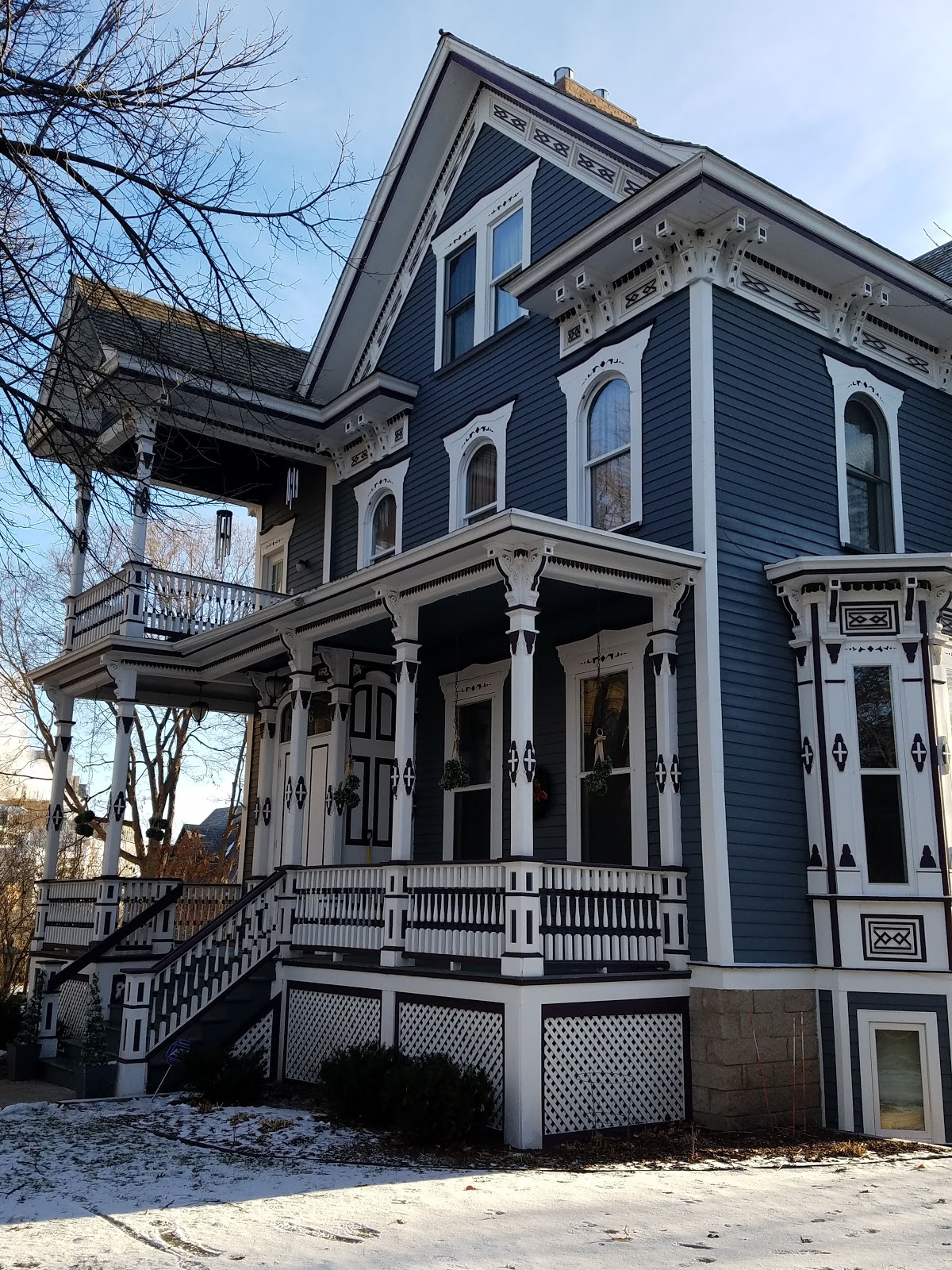
John McDonald House
The John McDonald House is an Italianate design from 1873. It was moved from its original location on Smith Avenue in 1978.

Waldmann Brewery
    The Waldmann Brewery, a former German lager saloon, is located in the oldest surviving commercial building in the Twin Cities. Built in 1857, it was reopened as a brewery in 2017, featuring "Wurst & Beer" in the old German style. We began our Christmas celebration here, it is one of my son's favorite restaurants.


     I always like to hear from my readers and promise to respond. My email address is MyVintageJourneys@gmail.com.

Related Posts: Victorian Homes Of Summit Ave, Saint Paul, MN - August 28, 2016
                        Vintage Journey to North Minneapolis, MN, Camden  - August 14, 2016


Historic Homes in Saint Paul, MN

Wednesday, November 28, 2018

MILA DISCOVERS "HOW THE GRINCH STOLE CHRISTMAS!"


Maybe Christmas, the Grinch thought, doesn't come from a store.                                        -Dr. Seuss

OLD GLOBE PLAZA
The Grinch endures for children and the “young at heart” in San Diego. This is the twenty-first consecutive year that Dr. Seuss's How the Grinch Stole Christmas! has been featured at the Old Globe Theater in Balboa Park. In the production, the Grinch's heart grows three times bigger, and I like to believe that everyone who attends this play departs with a bigger heart as well. 

I had been looking forward to sharing this San Diego holiday tradition with my granddaughter, Mila, for some time now, and finally decided that this was the year—she's four and one-half. When I told her about it, she was excited and it lead to many conversations about how and why this Grinch would steal Christmas. I was glad we were finally on our way to find out what really happened.
MILA
We chose an 11 a.m. performance on a Saturday in November. Mila and I meandered along El Prado to the Old Globe, enjoying the sunshine and other visitors who were starting to gather for another pleasant Saturday in the park. Mila had meticulously chosen her favorite dress and brown boots for the occasion. 
Today you are you! That is truer than true!
There is no one alive who is you-er than you!      
                                          -Dr. Seuss

The first thing we noticed when arriving at the theater was the white Christmas tree that towers over the plaza entrance during the holidays. It's decorated with banners that say “Merry” and pink candelabras that light up after dark. The tree is always a popular backdrop for photos, however, Mila did not care to have her photo taken today. The next thing she noticed was the snack bar; we sat down at one of the nearby tables and enjoyed a cookie and the many other snacks that her mother had sent along. 
OLD GLOBE THEATER SAN DIEGO
Plays at the Old Globe are always extremely well done with top quality performers, and this was no exception. Mila loved it and so did I. She might have been a bit frightened of the Grinch at times, but wouldn't admit it. I knew she was having a good time when she started singing along with the audience during one of the songs.
We sat up in the front which made it all the more exciting. The front row seats, off to the side, are priced in the least expensive ticket category, which is another reason I like to go to the Old Globe. It was a 90-minute performance with no intermission. 
San Diego has a special connection to Dr. Theodore Seuss Geisel (pen named: Dr. Seuss)–he was a long-time resident of LaJolla, a section of San Diego, where he lived from 1948 until his death in 1991. Audrey Geisel, his second wife, continues to carry on with his love of the arts, education, and literacy through numerous foundations and projects. 
Performances of Dr. Seuss's How the Grinch Stole Christmas! will continue through December 29, 2018. Tickets can be ordered by phone (619-234-5623) or online (TheOldGlobe.org.)

Sometimes you will never know the value of a moment until it

becomes a memory.    -Dr. Seuss 

FOUNTAIN AT BALBOA PARK SAN DIEGO


Tuesday, November 6, 2018

UŽUPIS-A TINY REPUBLIC IN VILNIUS, LITHUANIA


 UZUPIS
 Užupis is one of the tiniest republics in the world. It's located in Vilnius, the capital of Lithuania, a city we visited in September. My first thought, when I recently read an article read about it, is that we might have missed this small “nation” of free spirits. Then I remembered the quirky little Bohemian neighborhood (1 sq. km.) with a population of 7,000 where we strolled along the cobblestone streets and returned to enjoy the quaint outdoor cafes. One out of seven of the residents are artists, which explains the abundance of sculptures,  colorful wall murals, and art galleries. 

When Vilnius (pop.575,000) finally received independence from Russia in the 1990s, a group of locals got together to form a republic—kind of tongue in cheek, but not really. Užupis is not formally recognized by any other government, however, it has become a source of pride in Vilnius and throughout Lithuania. From 1941, when the Soviet Union invaded Lithuania, there was heavy censorship and many writers and artists were imprisoned. After 1990 came Lithuanian independence and restoration--art and literature once again flourished, free of forced ideology. Since 2002, The Angel of Uzupis (sculptor, Romas Vilčiauskas), has stood in the main square blowing a trumpet, and sending a message to the world that artistic independence is back in Eastern Europe after many years of oppression.
THE ANGEL OF UZUPIS

The Užupis Constitution, written in several languages, is posted on
mirrored plaques along a wall for everyone to see. It was written in a few hours by Tomas Čepaitis and Romas Lileikis in 1998 at the Republic's Parliament Bar, where the government meetings still convene most Friday evenings. The day they wrote it, Tomas couldn't get hot water at his home which explains why one of the 41 clauses is: Everyone has the right to hot water....” Others include: “Everyone has a right to celebrate their birthday or not celebrate their birthday.-----Everyone has a right to die, but this is not an obligation.------Everyone has the right to understand.----- Everyone has the right to understand nothing.-----People have the right to live by the River Vilhele, while the River Vilhele has the right to flow past people.”

BRIDGE TO UZUPIS

If I return to Vilnius again, it will be on April Fool's Day, or Užupis Independence Day, as locals call it. In addition to concerts and parades, this is the one day that travelers get their passports stamped as they cross the bridge into the Republic. They will also use the local (unofficial) currency and treat themselves to beer that flows from the water spout at the main square.
DOOR IN UZUPIS LITHUANIA

Thursday, October 25, 2018

BRYŃSK—A SMALL VILLAGE IN POLAND


The village of Bryńsk (formerly Bryńsk Kolonia) is located 173 km (107 miles) northwest of Warsaw, Poland. It's not a typical tourist destination—you could say it is “on the road less traveled.” However, when you are on a mission to find your roots, you may need to go to places that are out of the way and where little English is spoken.

This small village in northern Poland is where my grandmother, her siblings, and parents lived until they immigrated to the US in 1881. It was part of West Prussia and settled by Evangelic Germans after the third partition of Poland in 1795. Baptismal records indicate that my grandmother, Emma Nowak, and her siblings were baptized here. Most Germans fled Poland in the early 1900s. This village was almost completely destroyed by the Russians after World War II. The school, church and their home no longer exist. 

We recently spent some time in Warsaw and I was determined to make a side trip to Bryńsk (pop.700) to see with my own eyes where these ancestors came from. We had hoped to do it on our own, however, it quickly became clear that we were not going to get much accomplished without help. Fortunately, I was referred to a wonderful English speaking tour guide, Ula Modzelewska (Ula Warsaw Tours) who could drive us to the Lidzbark/Bryńsk area and spend the day with us.

LAKE LIDZBARK
Ula picked us up at 8 am. Our first stop was Lidzbark-Welski (pop. 8,500) where we visited the Evangelical and Catholic churches as well as two cemeteries. The town is on Lake Lidzbark and is a popular summer resort. However, it was quiet on this September day. We enjoyed a great homemade meal with meat, potatoes, and vegetables at Cabin Place—the only restaurant we could find open. 


BRYNSK - MAIN ROAD
It was about 3 pm when we left Lidzbark-Welski and headed south for the five-mile drive on the isolated, tree-lined road to Brynsk. The village is basically a straight line with about 150 homes on either side of the main street. It has one small grocery store, one Catholic church, one school, and a cemetery. This is the peaceful quiet area, surrounded by forests, where my ancestors decided to settle 150 years ago.

Ron, Michael, Susan
BRYNSK CATHOLIC CHURCH 
Our first stop was the Catholic church. Ula quickly scouted out a nearby neighbor who could open the church for us. She returned with Micheal Kwiatkowsky, the village councilman, who had a vintage skeleton key to the church and a smile on his face. He gave us a tour and told us about the church and the history of Bryńsk—all in Polish. Thankfully, Ula could interpret for us. She also made a video of the interview which she later sent to me. Michael generously shared part of his day with us, and after we left the church, he walked with us across the street to see the old Protestant cemetery. Unfortunately, there were no markings left on the gravestones or crosses. I had hoped that they would still be readable and I might find a tombstone with Nowak or Pikar written on it, but no such luck.

PROTESTANT CEMETERY
BRYNSK
Michael said that his grandmother told him about the beautiful brick homes that the Germans lived in and how impressive Brńysk was in the 1800s. He then went on to tell us that they were all destroyed by the Russians after World War II.

In 1864, records indicate that there was a wooden evangelic church and school located in Bryńsk Kolonia—they no longer exist. The current Catholic church was built in 1909 as a Protestant church and converted to a Catholic church after the war. 

It was getting late and time for us to head back to Warsaw. We slowly drove down the main street one last time, and Ula stopped so I could take photos. I could have lingered longer, but it was time go. 
BRYNSK GROCERY STORE
HOME IN BRYNSK
ORIGINAL 1909 PIPE ORGAN IN CHURCH
HOME IN BRYNSK


Thursday, October 4, 2018

RAEAPTEEK -THE OLD TOWN PHARMACY-TALLINN, ESTONIA


RAEAPTEEK MUSEUM 
In the medieval town square of Tallinn sits one of the oldest running pharmacies in all of Europe. The Old Town Hall Pharmacy, Raeapteek, has been in operation at the same location for over 600 years. Spanning over a period of 325 years and ten generations, it was run by the Burchart clan (1582-1911). The family maintained a tradition that the eldest son was always named Johann and studied to become a pharmacist.   
ENTRANCE TO PHARMACY

Today it's a popular tourist destination, not just to purchase medical supplies, but to peruse the wonderful small museum in a connecting room. It has examples of medicine and pharmacy goods that have been sold for centuries as well as other antique artifacts, rarities, and curiosities. 

Historically, the pharmacy was the place to go for medical advice, treatments, and spiritual assistance. A price list of pharmacy goods, dated 1695, gives an idea of what was sold in the Raeapteek during the Middle Ages: 54 different types of water, 25 fats, 32 balsams, 62 preserves, 128 different oils, and 71 medicinal teas. Also, on display are burnt bees, stallion hoofs, burnt hedgehogs, and dog feces that have been preserved in jars and used for medicinal purposes in previous times. 
VIEW FROM INSIDE THE OLD TOWN PHARMACY

The pharmacy was also popular as a meeting place where townspeople often stopped by for a popular glass of Claret. 
The medieval drink is made from Rhine wine, sugar, cinnamon, ginger, clove, mace, and saffron, and it can still be purchased at the pharmacy today.
                                                              * * *
The Raeapteek is located opposite the Town Hall at #11. Open Monday-Saturday 10:00 to 18:00. Entrance is free.


TINTED LIQUIDS ON DISPLAY IN THE WINDOW
OLD TOWN PHARMACY

TALLINN, ESTONIA


Monday, August 13, 2018

A YEATS EXPERIENCE IN NORTHWEST IRELAND


VIEW OF LOUGH GILL FROM THE BROC HOUSE
Last May, we had lunch at a contemporary home that was built on a hill overlooking Lough Gill in Sligo County on the northwest coast of Ireland. The picturesque lough (Gaelic word for lake), surrounded by woodlands, is five miles long and one mile wide. The surrounding landscape looks much as it did 150 years ago when William Butler Yeats frequented the area to spend time with his grandparents. 

As we drove up the tree-lined driveway to the Broc House, we were greeted by Damien Brennan and his wife, Paula Gilvarry. They welcomed us into their home. We enjoyed looking at Damien's collection of Irish paintings, and the spectacular view of the Lough Gill through the floor-to-ceiling dining room windows. We also stepped outside to see the lush green landscape and to hear a story about the hens that provide them with fresh eggs daily. Damien's maternal family ancestors have lived and farmed on this property since the early 19th century.

MICHAEL BRENNAN IN  KITCHEN
We were here to dine and to learn about William Butler Yeats from Sligo's local authority and President of the Sligo Yeats Society, Damien Brennan. With a love for all things Yeats, he has chosen to share his passion and knowledge with visitors from all over the world as they pass through Sligo—often referred to as Yeats country. Lough Gill and Sligo county were the inspiration for many of Yeats famous writings making it a perfect setting for a Yeats Experience

IRISH LUNCHEON 
Damien read to us on several occasions throughout the leisurely lunch that we shared with a tour group from the US. He was reading from a rather well-used Complete Works of W.B. Yeats. This old classic book appeared a bit worn and crumpled. I would guess that he could quote much of it from memory. As he explains it, he has a passion for Yeats and enjoys sharing it with others. His hope is that guests will leave with a desire to pick up a book about Yeats and learn more about him. Yeats was born in Dublin and was awarded the Nobel Prize for Literature in 1923. 

There are 20 islands on Lough Gill, however, the most well-known is the Island of Innisfree—the subject of one of Yeats most popular poems. It was written in 1888 while he was in London and at a time when he was wishing to escape the city to the countryside. Although I find it difficult to understand much of his writings, I do appreciate this poem about Innisfree. Perhaps, because as a youth I also longed to leave the city and spend time at my parent's lake cabin whenever possible. 

"The Lake Isle of Innisfree"

I will arise and go now, and go to Innisfree,
And a small cabin build there, of clay and wattles made;
Nine bean-rows will I have there, a hive for the honey-bee,
And live alone in the bee-loud glade. 

And I shall have some peace there, for peace comes dropping slow.
Dropping from the veils of the morning to where the cricket sings,
There midnights all a glimmer, and noon a purple glow.
And evening full of the linnet's wings.

I will arise and go now, for always night and day,
I hear lake water lapping with low sounds by the shore;
While I stand on the roadway, or on the pavements grey,
I hear it in the deep heart's core.
                                W.B. Yeats, 1865-1939

                                                        * * *

We first heard about the Yeats Experience on the PBS series: Samantha Brown's Places to Love - Ireland's Northwest Coast. Samantha interviewed Damien at the Broc House. It was so interesting that I sent him an email requesting a reservation for the one day we would be in the area—this was many months before our arrival. He responded immediately and said that he had a tour group scheduled for lunch on that day and that we could join them. We were delighted. It was one of the highlights of our month in Ireland. (Damien later told us that when Samantha arrived for the story she was accompanied by a large camera crew of seven and a drone that was equipped with a camera.) 

The Broc House is about five miles from Sligo. Taxi from Sligo is 10E.

Related Posts: A Vintage Walk in Dingle - July 14, 2018
                        Stone Fences & Walls of Ireland - June 27, 2018
                        Ireland: Nine Reason to Return - June 14, 2018
                     
BROC HOUSE SLIGO COUNTY IRELAND


Tuesday, July 31, 2018

"PACIFIC SOUL" - JOINING TOGETHER HUMANITY THROUGH ART


PACIFIC SOUL, 2018

If you've passed by Broadway and Pacific Highway in downtown San Diego anytime recently, you've probably noticed a monumental 25-foot white sculpture sitting at the base of the newly opened Pacific Gate luxury residential towers.

This sculpture entitled, the Pacific Soul, is the work of internationally renowned Jaume Plensa. He is the recipient of numerous awards and his works can be found in galleries, museums, and outdoor spaces throughout the US, Europe, and Asia. The Crown Fountain, 2004, in Chicago's Millennium Park is one of his many famous projects in public places. Plensa currently resides and works in Barcelona, Spain.

PACIFIC SOUL, 2018
The Pacific Soul is shaped like a crouching human body that is looking toward the nearby Pacific Ocean and is painted in a brilliant white color to reflect the west coast light. It was created with large stainless steel stylized characters from the Latin, Hebrew, Greek, Cyrillic, Arabic, Japanese, Chinese and Hindi alphabets—symbolizing the joining together of humanity through art. The elongated letters at the base give the appearance of roots. The project, commissioned by BOSA Development, opened in January 2018 and was over a year in the making.

Next time you pass by, take time to linger and enjoy this famous work of art that has raised the San Diego public art scene to a new level. 

“....I hope my sculpture will be an icon for the city, embracing the diverse community which is always changing yet always intrinsically connected to the ocean.”
                                                                   -Jaume Plensa

December 5, 2018 Addendum:
Last evening, as I walked from the Santa Fe Train Depot to the Broadway Pier, I passed the Pacific Soul with its bright lights shining. It was spectacular. I'm sharing the photos, including one that I took while standing inside the sculpture looking up at the night sky.